



Streptopelia decaocto (Eurasian Collared Dove)
The Eurasian Collared Dove also known as Streptopelia decaocto is a graceful bird species known for its pale grey plumage, black collar on the nape, and distinctive cooing call. Found across Europe and Asia, including the Indian subcontinent, this dove has successfully adapted to a range of environments—from urban towns to agricultural fields. In regions like the Great Himalayan National Park (GHNP), the Eurasian Collared Dove adds charm to the avifaunal diversity, offering birdwatchers a serene sight.
Physical Characteristics
The Eurasian Collared Dove typically measures around 32 cm in length with a wingspan of 47–55 cm. It is easily identified by the black half-collar on the back of its neck, pale grey body, and reddish eyes. Its flight is swift and direct, with occasional glides and rhythmic wing beats. The bird’s soft cooing is a familiar and soothing sound across its range.
Habitat and Range
Originally native to warmer temperate and subtropical regions, the Eurasian Collared Dove has expanded its distribution rapidly across continents. In India, and particularly in eco-regions like GHNP, the dove is frequently seen perched on power lines, rooftops, or trees near villages and farmlands. It prefers open habitats, often avoiding dense forests but adapting well to semi-urban areas and edges of woodlands.
Behavior and Diet
This species is generally monogamous and can be seen in pairs or small flocks. The Eurasian Collared Dove feeds primarily on grains, seeds, and occasionally small insects. In GHNP, it benefits from the agricultural landscapes and human settlements along the park’s buffer zones, where food is abundant.
Nesting is simple—a loosely built structure of twigs placed in trees or on buildings. Breeding occurs throughout the year, especially during warmer months.
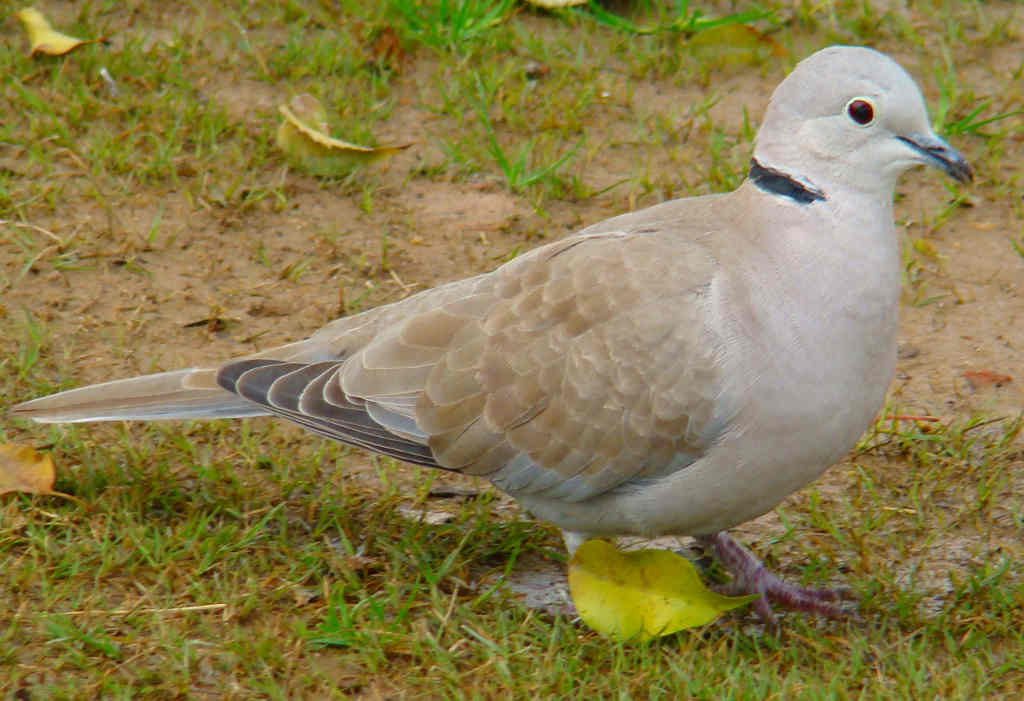
Streptopelia decaocto – Eurasian Collared Dove (click to enlarge)
| Common name | Eurasian Collared Dove |
| Scientific name | Streptopelia decaocto |
| Family | Columbidae |
| Description | It is a medium-sized dove, distinctly smaller than the wood pigeon, similar in length to a rock pigeon but slimmer and longer-tailed, and slightly larger than the related turtle dove, with an average length of 32 cm, with a wingspan of 47–55 cm, and a weight of 125–240 g. It has a black half-collar edged with white on its nape from which it gets its name. The short legs are red and the bill is black. The iris is red, but from a distance the eyes appear to be black, as the pupil is relatively large and only a narrow rim of reddish-brown iris can be seen around the black pupil. The eye is surrounded by a small area of bare skin, which is either white or yellow. It is a widespread resident in Himachal Pradesh. |
Importance in Ecosystems
As a granivore, the Eurasian Collared Dove helps in seed dispersion and pest control by feeding on insects. It also plays a role in sustaining the food web, serving as prey for larger birds of prey. Its presence near human settlements can indicate a healthy balance between wildlife and human activity.
Conclusion
The Eurasian Collared Dove (Streptopelia decaocto) is more than just a common bird—it is a symbol of adaptability and ecological harmony. In protected landscapes like the Great Himalayan National Park, it stands as a testament to how wildlife and human-modified environments can coexist. Its soft call and peaceful demeanor contribute to the tranquil atmosphere of the region, making it a favorite among bird enthusiasts and nature lovers alike.