



Megalaima virens (Great barbet)
Megalaima virens, commonly known as the Great Barbet, is the largest and one of the most colorful barbets found in the Great Himalayan National Park (GHNP). Distinguished by its vivid green, blue, and yellow plumage and loud, resonant calls, Megalaima virens is a frequent presence in the mid-elevation forests of the park. Its unmistakable “piou-piou” calls echo through the valleys, often serving as the first sign of its presence before it becomes visible.
For birdwatchers and nature lovers visiting GHNP, spotting the Great Barbet amid the dense canopy is a thrilling experience.
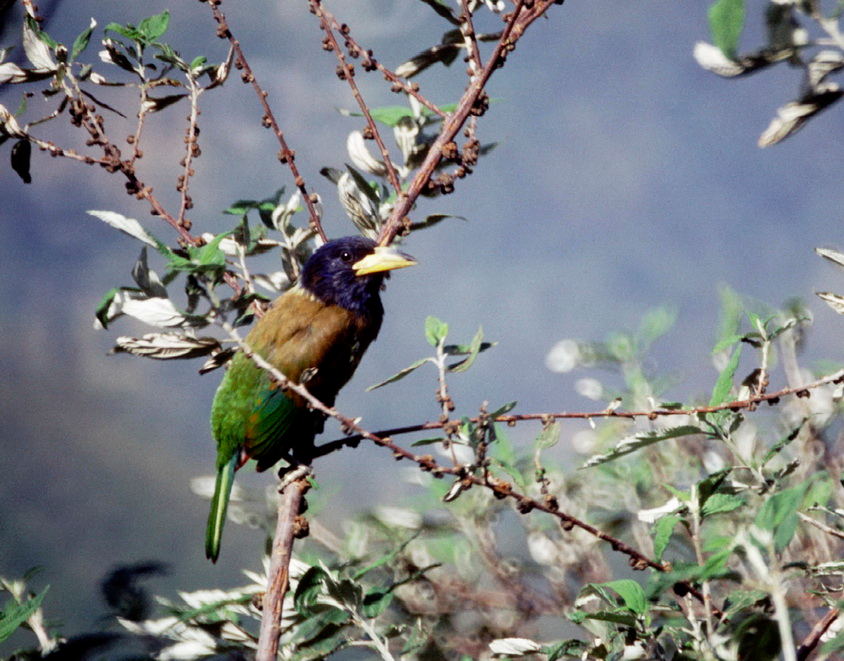
Megalaima virens-Greatbarbet (click to enlarge)
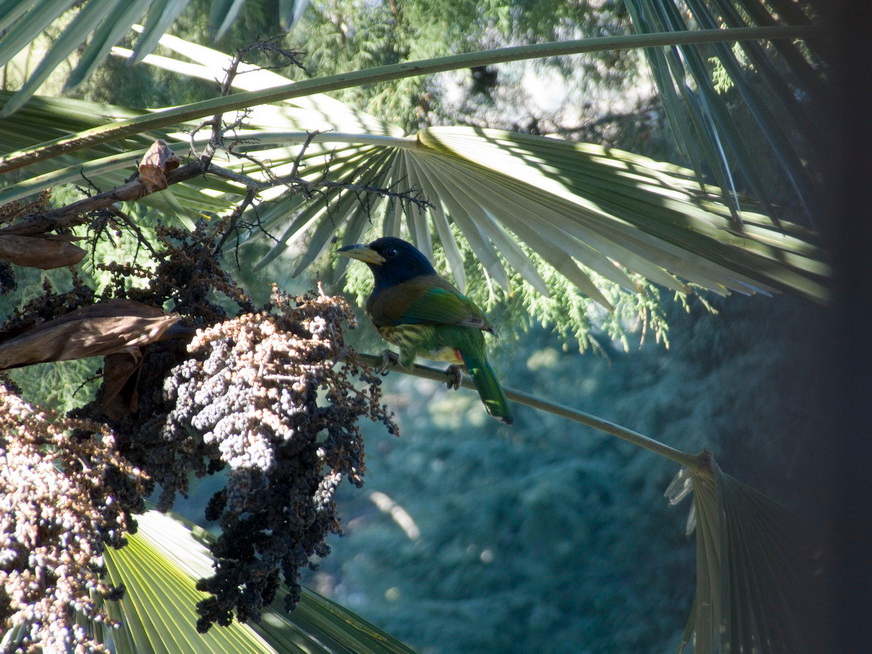
Megalaima virens-HillBarbet (click to enlarge)
Habitat and Distribution in GHNP
In the Great Himalayan National Park, Megalaima virens is primarily found between 1,200 and 2,800 meters elevation, inhabiting broadleaf forests, mixed woodlands, and forest edges. It prefers areas rich in fruiting trees and is often seen perched quietly on high branches or flying between treetops.
Within GHNP, the Sainj and Tirthan valleys provide excellent habitats for the Great Barbet, especially in forest belts with abundant figs and wild fruits. During the warmer months, it may be seen at slightly higher altitudes, descending during colder periods in search of food.
| Common name | Great Barbet |
| Scientific name | Megalaima virens |
| Family | Megalaimidae (Barbets) |
| Description | A brightly colored barbet with a heavy yellow bill, with bristles at its base–maroon-brown with violet blue-black head; olive-brown, blue, and yellow below with a bright scarlet patch under the tail. The sexes are alike. It is a common resident species of the moist forests of Himalayas, from 1000 to 3000 meters—found lower down in winter. The Great Barbet is a very common bird in Shimla area and usually likes to sit on the top of Deodar trees and gives a call from the top. Seen singly or in small feeding parties. Congregations of 30 or more are found in large fruiting trees. Though with gaudy coloration, it is difficult to view amongst foliage, especially in winter, when it is silent—feeds chiefly on fruits and insects. It has a distinct sound repeated monotonously, throughout the day, in irregular choruses by several birds, which intensifies at sunset |
Behavior and Diet
Megalaima virens is mainly frugivorous, feeding on a variety of wild fruits, figs, and berries, though it also consumes insects and nectar occasionally. Its strong beak helps it pluck fruits and hollow out nesting cavities in dead trees or softwood branches.
The Great Barbet is generally solitary or found in pairs, though small groups may form when food is plentiful. It is known for its loud, repetitive calls, particularly during the breeding season from April to July, when it establishes and defends its territory vigorously.
Conservation Significance
Megalaima virens is listed as a species of Least Concern but is sensitive to habitat loss and forest degradation. The well-protected forests of the Great Himalayan National Park offer critical refuge to this striking bird. Maintaining GHNP’s pristine forest ecosystems ensures the continued survival of species like the Great Barbet, which depend on mature trees for nesting and fruit-bearing vegetation for food.
The presence of the Great Barbet in GHNP is a strong indicator of a healthy, functioning forest ecosystem.