



Moschus leucogaster (Himalayan musk deer)
The Himalayan musk deer (Moschus leucogaster) is one of the most elusive and ecologically significant mammals found in the Great Himalayan National Park (GHNP). Renowned for its musk gland, which has made it a target for illegal poaching, this shy herbivore plays a critical role in the fragile alpine and subalpine ecosystems of the Western Himalayas.
Identification and Behavior
The Himalayan musk deer is small and deer-like, with thick brownish-grey fur that helps it blend into the rocky, forested slopes of GHNP. Males are distinguished by elongated upper canines that protrude like small tusks, and only males produce the highly valued musk. These deer are mostly crepuscular, active during dawn and dusk, and are solitary in nature.
Their diet consists mainly of grasses, leaves, twigs, and mosses. Unlike other deer species, the Himalayan musk deer lacks antlers and prefers rugged terrain at elevations between 2,500 and 4,000 meters.
Habitat in GHNP
Within GHNP, the musk deer thrives in dense oak and rhododendron forests, alpine scrublands, and steep rocky slopes. The remote and protected environment of the park offers a vital refuge from habitat destruction and poaching pressures.
GHNP’s high-altitude terrain provides an ideal environment for species like the Himalayan musk deer, as well as other rare animals such as the snow leopard and Western tragopan. The park’s designation as a UNESCO World Heritage Site emphasizes its global importance in wildlife conservation.
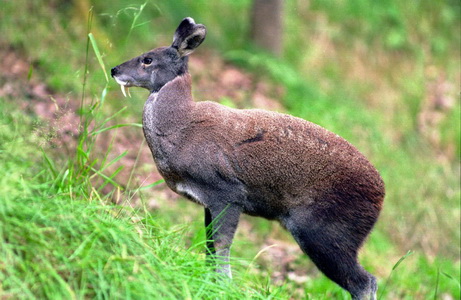
Moschus leucogaster – Himalayan Musk deer
| Common name | Himalayan Musk Deer |
| Latin name | Moschus leucogaster Hodgson |
| Local name | Kastura |
| IUCN/WPA/Indian status | Endangered/locally common |
| Social unit | Solitary, except when female is with young |
| Size / weight | HBL: 86-100 cm, HAS: 50 cm. Weight : 13-18 Kg |
| Description | A shy, brownish yellow, dog sized, mountain ruminant, the Himalayan Musk deer can be differentiated from the alpine musk deer in having dark legs and chest with no chest stripe. The under parts are pale, rump and buttocks are dark, The face is grayish brown and the eye may or may not have an eye ring, which when present is faint and grayish. The ears are brown on the back, but have grey rims insides. |
| Behavior | Communication is chiefly by olfaction. The deer sent marks by defecation and secretion of caudal, musk and inter digital glands |
| Distribution | The Himalayas from central Kashmir through Himachal Pradesh up to Sikkim |
| Habitat | Subalpine oak and rhododendron forests ( 3000-4300 m) medium to high elevation coniferous forest in the Western Himalayas below the tree line ( 2500-4400 m) in Sikkim, thick bamboo forests below alpine zone ( 2600-300 m |
Conservation Status
Classified as Endangered on the IUCN Red List, the Himalayan musk deer faces threats from habitat loss and illegal hunting for musk. GHNP’s strict conservation laws and limited human access help protect this species within park boundaries.
Conservation initiatives include the Wildlife Institute of India’s research programs and local community involvement in safeguarding biodiversity. Further, raising awareness through ecotourism and education can help reduce demand for illegal wildlife products.
Conclusion
The Himalayan musk deer in the Great Himalayan National Park represents the park’s commitment to preserving rare and endangered species. As a keystone species, it plays an essential role in the region’s ecological balance. Observing this elusive deer in its natural habitat is a rare privilege and underscores the need for continued protection of GHNP’s pristine environment.