



Hemitragus jemlahicus (Himalayan tahr)
The Himalayan tahr (Hemitragus jemlahicus) is a large ungulate native to the rugged slopes of the Himalayas, including the alpine zones of the Great Himalayan National Park (GHNP). This sure-footed herbivore is an integral part of the park’s high-altitude ecosystem, playing a crucial role in the region’s food web and biodiversity.
Physical Characteristics
The Himalayan tahr is instantly recognizable by its thick reddish-brown coat and impressive backward-curving horns, which are more prominent in males. Its dense coat provides insulation in extreme mountain climates. Adult males can weigh up to 100 kilograms and display a heavy mane that makes them appear even larger.
Habitat and Range
In GHNP, Himalayan tahrs are typically found between elevations of 2,500 to 5,000 meters. They prefer steep, rocky slopes and cliff faces where they can escape predators with agile climbing. These habitats provide both safety and access to alpine grasses, shrubs, and herbs—core components of their diet.
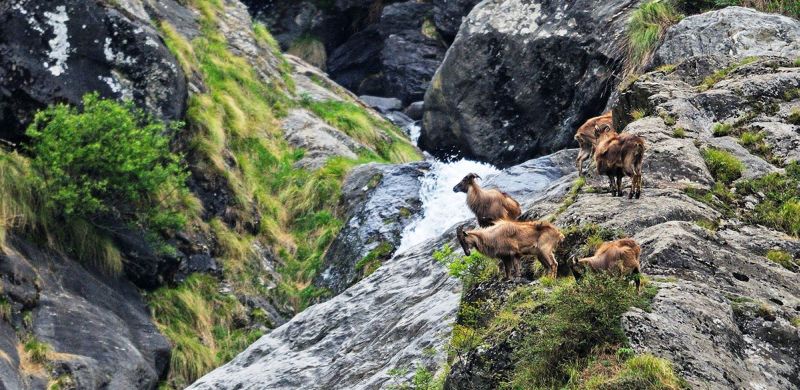
Hemitragus jemlahicus – Himalayan tahr (click to enlarge)
Common name
Himalayan Tahr
Latin name
Hemitragus jemlahicus C.H.Smith 1826
Local name
Karth
IUCN/WPA/Indian status
Near threatened /I/Uncommon
Social unit
Mixed herds of up to 75 animals, group size in spring 5-6 comprising female and offspring’s, yearlings and one or two sub adults
Size / weight
HBL: 130-170 cm.(male) 90 cm (female),Less than 25 cm ( female) AS: up to 46 cm female horns smaller WEIGHT : 90-125 kg(male),55-72 kg (female)
Description
The Himalayan Tahr male is a deep copper brown mountain goat while ewes and younger males are light brown. The male Tahr has a coarse, tangled mane over its neck and chest, and a mantle that covers the flanks down to its thighs. The horns on both sexes are close-set, short, laterally compressed, wrinkled and having a sharp keel on the anterior edge.
Behavior
Adult males segregate into all male herds in spring and rejoin females in the autumn.
Distribution
Fragmented distribution in western and central Himalayas from Jammu & Kashmir (rare: west of Doda) to Sikkim.
Habitat
Temperate and subalpine forests precipitous terrain with grass cover and slopes with oak and bamboo forests. In the Greater Himalayas, found on southern forested slops(1550-5300 m although they prefer higher altitudes between 2000-4400 m).
Best seen
Kedarnath WLS Uttarakhand
Behavior and Diet
Tahrs are gregarious animals and usually form herds, particularly during the winter. Males often live in separate bachelor groups outside the mating season. Their diet varies seasonally, with summer months offering abundant grazing material, while winter forces them to browse woody plants and climb lower for food.
Role in the Ecosystem
As herbivores, Himalayan tahrs influence the vegetation structure of alpine regions. They also serve as prey for apex predators such as the snow leopard and Himalayan wolf, making them key players in the local ecological balance.
Conservation Status
Though listed as Near Threatened by the IUCN, the population of Himalayan tahr is considered stable in protected areas like GHNP. However, habitat loss and poaching remain concerns in unprotected zones. Conservation efforts within GHNP, including habitat management and anti-poaching patrols, are essential for safeguarding this species.