



Snow leopard (Panthera uncial)
The snow leopard (Panthera uncia) is one of the most elusive and iconic predators of the Great Himalayan National Park (GHNP). Adapted to the cold, rugged high-altitude environment, this majestic big cat symbolizes the wild beauty and ecological significance of the Himalayas.
Physical Features and Adaptations
Snow leopards are medium-sized wild cats known for their thick, smoky-grey fur marked with dark rosettes and spots. Their long, bushy tails help with balance and also act as a warm wrap during freezing temperatures. Short forelimbs, long hind limbs, and wide, fur-covered paws make them agile climbers—perfectly suited to the rocky terrain of GHNP’s alpine zones.
Habitat and Distribution in GHNP
In the Great Himalayan National Park, snow leopards inhabit elevations between 2,700 to over 5,000 meters. Their range spans steep cliffs, rocky outcrops, and snow-covered slopes, primarily in areas like Tirthan Valley, Sainj Valley, and the Rakti-Sar region. GHNP provides a relatively undisturbed habitat crucial for the survival of this secretive predator.
Behavior and Diet
The snow leopard is solitary and primarily crepuscular, hunting at dawn and dusk. It preys on blue sheep (bharal), Himalayan tahr, musk deer, and smaller mammals such as marmots and hares. Their extraordinary leaping ability—up to 15 meters—makes them efficient predators in mountainous terrain.
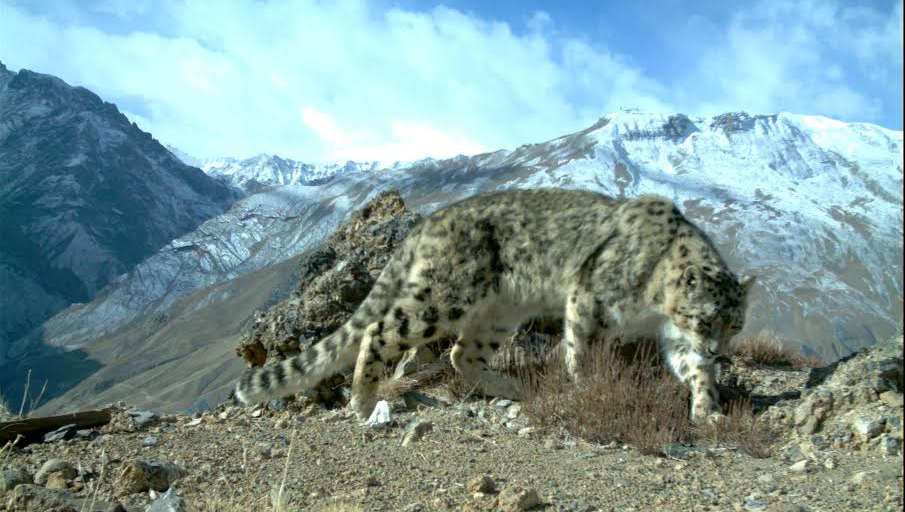
Panthera uncial – Snow leopard captured by camera trap ( Click to enlarge)
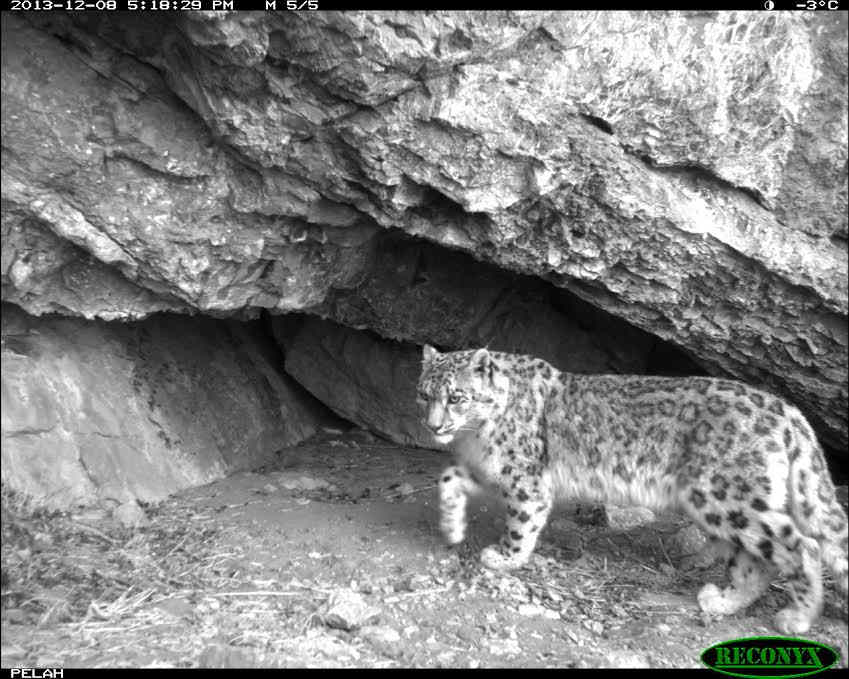
Snow leopard ( Click to the enlarge)
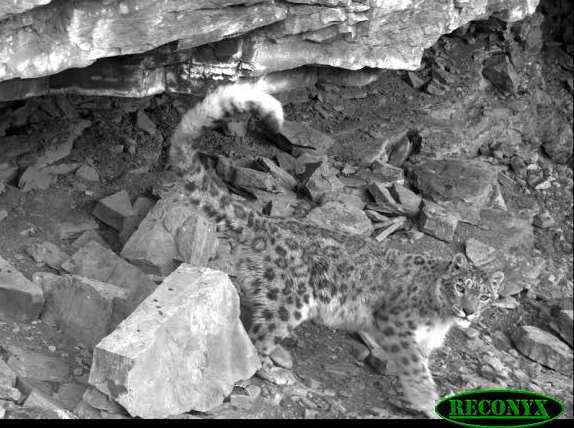
Snow leopard ( Click to enlarge)
| Common name | Snow leopard |
| Latin name | Panthera uncial Schreber 1775 |
| Local name | Barfani cheetah |
| IUCN/WPA/Indian status | Endangered/I/Uncommon |
| Social unit | Solitary, although overlap of home ranges of males with other males and with females have both been recorded. |
| Size / weight | HBL: 86-125 cm. TL : 80-105 cm. WT : 45-55 kg(males) 35-40 kg ( females) |
| Description | One of the most aptly named animals, the Snow leopard is adapted completely to live in snow covered areas. It is marginally smaller then the common leopard, with a more luxuriant coat. It has back spots on its limbs and face and its pale smoky grey coat with ghostly dark grey rosettes , allow for excellent camouflage. The ears are short and round , and the back of ears have black edges and are pale. The snow leopard’s limbs are long and muscular , the chest is deep and the paws are massive in comparison to its body, all of which help to fell the large prey that it often needs to hunt. |
| Behavior | Despite being a large carnivore, the harsh terrain and climate that it lives in forces the snow leopard to have a wide dietary range including rodents birds and wild goats. It kills every 10-15 days and it has been estimated to have a large prey consumption of approximately 20-30 adult Bharal annually. During the lean season small alpine mammals such as marmots pikas and hare comprise a fair share of its diet. |
| Distribution | Through the high Himalayas from Jammu & Kashmir to Arunachal Pradesh and trans Himalayas of Ladakh, Lahaul –Spiti, Gangotri and Tso Lhamo.Its range approximates the geographical range of its large prey the Bharal and the Ibex. |
| Habitat | Alpine as well as subalpine and scrub above the tree line. It favours lightly forested and steep terrain with rocky, broken country(1800-5800 m). Prefers areas with proximity to cliffs. |
| Best seen | Hemis NP, Ladakh, Jammu & Kashmir |
Conservation Status
Listed as Vulnerable by the IUCN, snow leopards face threats from habitat loss, poaching, and retaliation killings due to livestock predation. GHNP plays a critical role in their conservation by offering protected corridors, abundant prey, and anti-poaching efforts. Conservation partnerships with local communities help mitigate human-wildlife conflict in the buffer zones of the park.
Importance to Ecosystem
As apex predators, snow leopards help maintain healthy populations of herbivores and balance within the alpine ecosystem. Their presence is an indicator of ecological integrity in GHNP and contributes to its designation as a UNESCO World Heritage Site.