



Ursus arctos (Himalayan brown bear)
The Himalayan Brown Bear (Ursus arctos) is one of the most iconic and endangered large mammals found in the Great Himalayan National Park (GHNP). As a subspecies of the brown bear, it is specially adapted to the high-altitude alpine and subalpine habitats of the western Himalayas.
Physical Characteristics
The Himalayan brown bear is easily recognized by its light brown to sandy-colored fur, powerful limbs, and large frame. Adult males can weigh up to 200 kilograms, making it the largest carnivore in the region. They have a pronounced shoulder hump, a typical trait of brown bears, and sharp claws that help them dig for roots and insects.
Habitat and Distribution in GHNP
In GHNP, the Himalayan brown bear primarily inhabits high-altitude meadows, alpine scrublands, and glacial valleys, typically found between 3,200 and 4,800 meters above sea level. These bears are solitary animals and require large territories for foraging.
Diet and Behavior
Despite their fearsome appearance, Himalayan brown bears are omnivorous, feeding on a mix of roots, grasses, berries, insects, and small mammals, and occasionally preying on ungulates. They are also known to raid livestock, which sometimes causes conflict with local communities.
They hibernate during the winter months, retreating to self-dug dens in sheltered slopes. Activity resumes in the spring as the snow melts and food becomes available.
Conservation Status and Threats
The Himalayan brown bear is listed as Critically Endangered in India due to its extremely low population and limited habitat range. Major threats include habitat degradation, human-wildlife conflict, and poaching. GHNP provides a crucial protected area for this species, although sightings remain rare due to its shy nature and rugged habitat.
Importance in Ecosystem
As apex predators and scavengers, Himalayan brown bears play a vital role in the ecosystem by regulating herbivore populations and assisting in nutrient recycling.
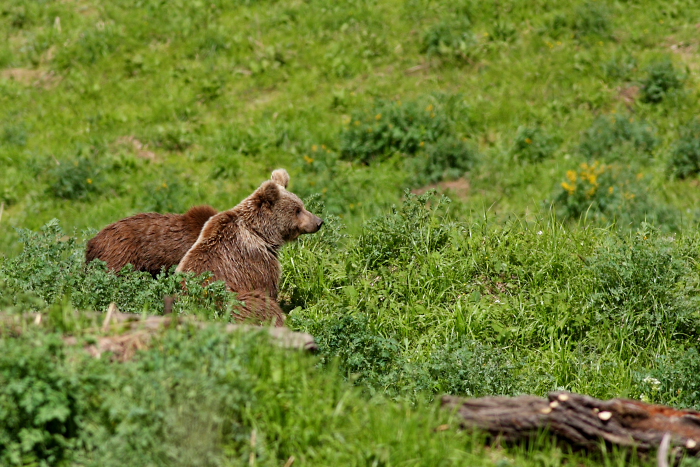
Ursus arctos – Himalayan brown bear
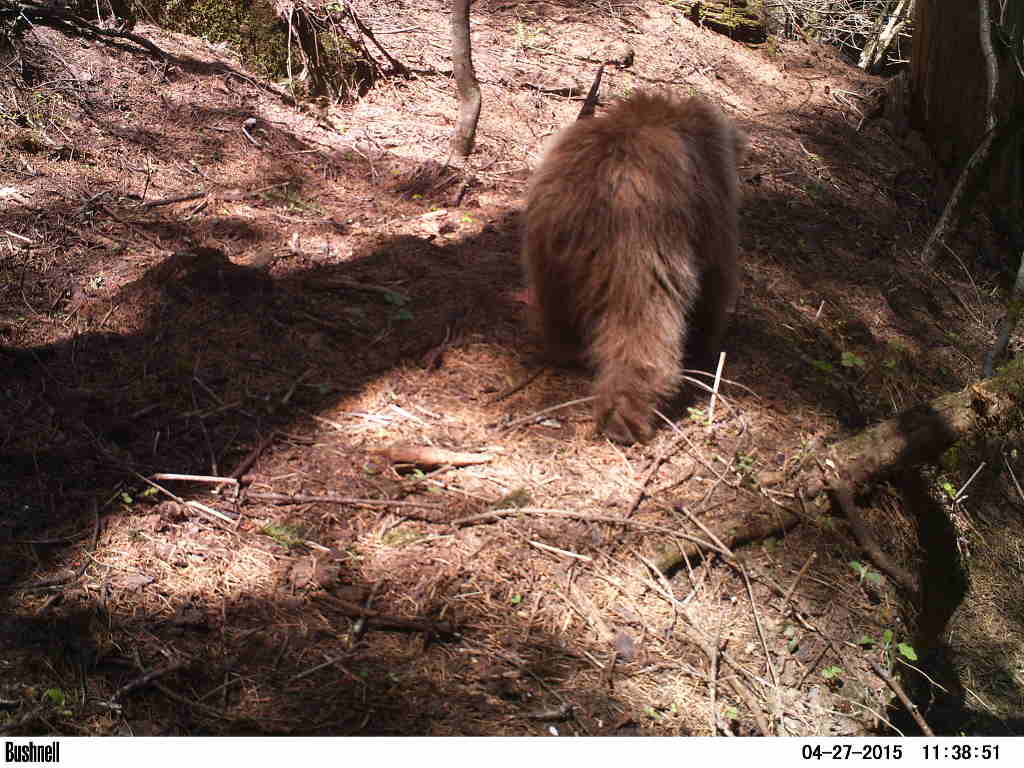
Brown bear photographed in GHNP ( Click to enlarge)
| Common name | Himalayan brown bear. |
| Latin name | Ursus arctos Linnaeus 1758 |
| Local name | Lal bhalu |
| IUCN/WPA/Indian status | Least concern/II/Rare |
| Social unit | Solitary |
| Size / weight | HBL : 150-280 cm. WT : 130-550 kg. (male) 80-250 kg ( female) |
| Description | The Himalayan brown bear is the world’s largest terrestrial carnivore. It is considerably smaller than its more famed relatives the Grizzly and the Kodiak bears. However, it s still a very large bear with a thick reddish brown coat with no clear chest markings is seen and this can be visible even in some adults in a new summer coat. The coat is shorter in summer and longer in winter. |
| Behavior | This is the least arboreal bear and is largely terrestrial as an adaptation to life in the rolling uplands above the tree line . It hibernates in winter. |
| Distribution | Through the Western Himalayan states of Jammu & Kashmir Himachal Pradesh and Uttarakhand (3000-5000 m) |
| Habitat | It is not primarily a forest animal and inhibits alpine scrub and meadows above the tree line although it is occasionally found in subalpine forests. |
| Best seen | Great Himalayan NP. Himachal Pradesh |
Conservation Status and Threats
The Himalayan brown bear is listed as Critically Endangered in India due to its extremely low population and limited habitat range. Major threats include habitat degradation, human-wildlife conflict, and poaching. GHNP provides a crucial protected area for this species, although sightings remain rare due to its shy nature and rugged habitat.
Importance in Ecosystem
As apex predators and scavengers, Himalayan brown bears play a vital role in the ecosystem by regulating herbivore populations and assisting in nutrient recycling.