



Ursus thibetanus (Himalayan black bear)
The Himalayan black bear (Ursus thibetanus) is a prominent yet elusive mammal inhabiting the broadleaf and coniferous forests of the Great Himalayan National Park (GHNP). Known for the distinctive white “V”-shaped patch on its chest and its adaptability to diverse altitudes, this subspecies of the Asiatic black bear is a key component of GHNP’s rich biodiversity.
Physical Characteristics and Behavior
Adult Himalayan black bears are robust animals with glossy black coats, small rounded ears, and sharp claws used for climbing and digging. Males can weigh up to 180 kg, with females slightly smaller. The species is largely nocturnal and solitary, though occasional sightings during the day are not uncommon, especially in autumn when food scarcity drives them to forage more actively.
They are excellent climbers and swimmers, often seen foraging on fruit trees or near rivers. These bears enter a state of winter torpor, especially in higher elevations where food is scarce.
Habitat within GHNP
In GHNP, the Himalayan black bear is primarily found between 1,200 and 3,300 meters, frequenting areas rich in oak, rhododendron, and conifer forests. In summer, they may move to higher altitudes in search of fruits and berries, returning to lower elevations in autumn.
GHNP provides an ideal sanctuary due to its undisturbed habitats, limited human interference, and protected status, which minimizes poaching and habitat degradation.
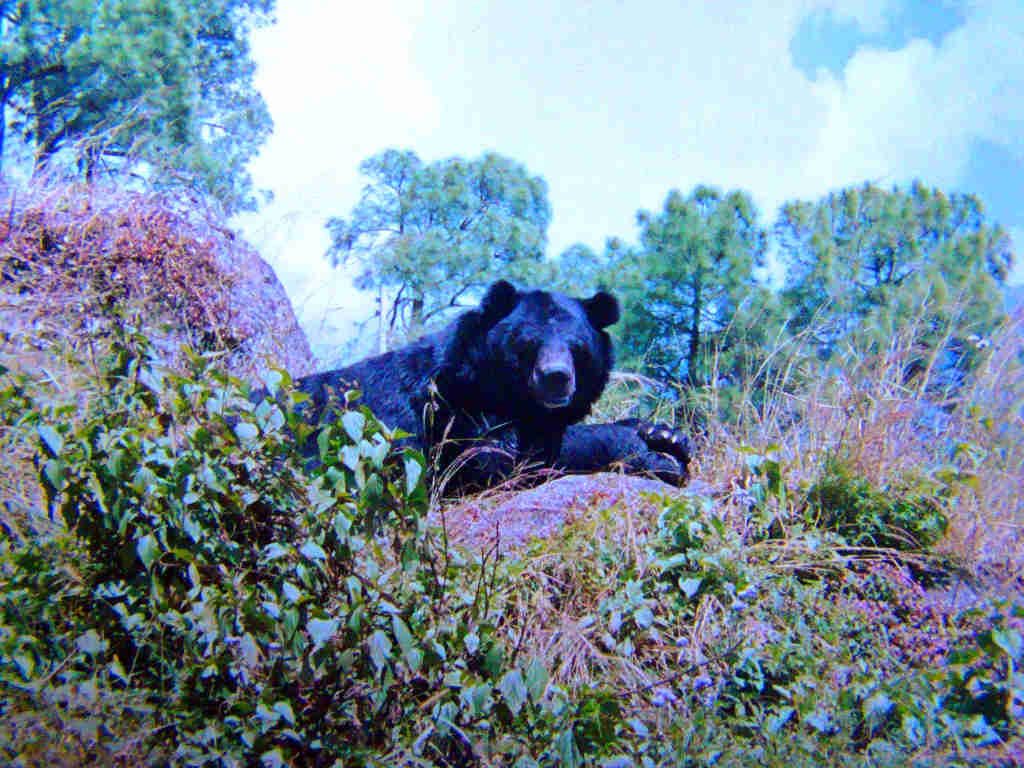
Ursus thibetanus – Himalayan black bear in GHNP ( Click to enlarge)
| Common name | Himalayan Black Bear |
| Latin name | Ursus thibetanus |
| Local name | Reechh, |
| IUCN/WPA/Indian status | Vulnerable/ I/ Uncommon |
| Social unit | Solitary, or utp to four bears when mother is with cubs |
| Size / weight | HBL: 110- 190 cm, TL: 7.5 – 10 cm, Wt. 60-250 Kg (male) 35-170 Kg (Female) |
| Description | A large forest-dwelling bear of the Himalayas, also called Asiatic black bear or Moon bear due to the crescent-shaped creamy or white mark on its glossy black chest. Its black fur is much shorter than that of the other black bear of India, the Sloth bear, it muzzle is shorter and tan-brown, the brown colour stopping short below the eyes and its chest marking is crescent shaped instead of V shaped and extends all the way to its armpits. The chin is white. Longer hairs are present in the neck region, probably an evolutionary adaptation to escape the bites of predators such as tigers. It has powder-puff ears that are very noticeable and a very short tail. The feet are large with black pads and form the largest tracks among Indian bears. The claws on its digits are pronouncedly curved and dark black in colour, longer on the forefoot than the hind foot but shorter than those of the Brown and Sloth bears. |
| Behavior | Arboreal, ascending trees to feed on fruits or honey or escape intrusion though it does not sleep on trees like the Sun Bear. |
| Distribution | Throughout Himalayas from Jammu & Kashmir to Arunachal Pradesh and in hilly regions of other north- eastern states. |
| Habitat | The species prefers heavily forested broadleaved and coniferous forestas as habitat. It uses orchards, agricultural fields and human habitation to move between forest patches. |
Diet and Ecological Role
The Himalayan black bear is omnivorous, feeding on a mix of berries, roots, nuts, insects, small mammals, and carrion. Their foraging habits help in seed dispersal and maintaining forest health.
While generally shy, they can become aggressive when surprised or during encounters with humans, especially when protecting cubs or food sources.
Conservation Status and Threats
The species is listed as Vulnerable on the IUCN Red List, with its population declining due to habitat loss, poaching for body parts, and human-wildlife conflict. GHNP plays a crucial role in the conservation of this bear by offering legal protection, habitat security, and active anti-poaching measures.
Tips for Spotting in GHNP
While difficult to observe due to their shy nature, signs such as claw marks on trees, droppings, and tracks are sometimes visible along forest trails. The Sainj and Tirthan valleys occasionally report bear activity, especially during the fruiting season (July to October).