THE OFFICIAL WEBSITE OF THE GREAT HIMALAYAN NATIONAL PARK
+91 1902 265320
dirghnp@gmail.com
Accessibility
Screen Reader
Decrease Font Size Default Font Size Increase Font Size
Great Himalayan National Park
  • Home
  • About
    • About UNESCO WHS
    • Park Introduction
    • Park History
    • People’s Contribution
    • Facts & Figure
    • Climate
    • Biogeography
    • Flora and Fauna
    • Maps
    • Terrain
      • General Geography
      • Geology
      • Rock and Soil
      • Hydrology
      • Erosion
      • Landslides
  • Destinations
    • Tirthan Valley
    • Sainj Valley
    • Parvati Valley
    • Jiwa Nal Valley
  • Activities
    • Treks
    • Local Sightseeing
    • Season Based Activities
  • Plan
    • Current Conditions
    • Access
    • Fees, Rules and Guidelines
  • Biodiversity
    • Fauna
    • Flora
  • Contact
    • Contact Details
    • Emergency Contacts
  • Book Your Stay
  • Login
Plan Your Trip
Accommodation Trek Permits
Place of Stay
Forest Rest House Shangharh
Forest Rest House Ropa/ Sainj
Forest Complex – Shai Ropa
Rooms
Dormitory
1
2
1
2
3
4
5
6
7
8
9
10
Place of Stay
Forest Rest House Shangharh
Forest Rest House Ropa/ Sainj
Forest Complex – Shai Ropa
Rooms
Dormitory
1
2
1
2
3
4
5
6
7
8
9
10
  • Corringendum regarding interview postponed for NLC Vacancy
  • Corringendum regarding interview schedule of NLC Vacancy
  • Vacancy under Nature Learning Centre Project in GHNP Shamshi
  • Tender Cancellation : Cancellation of E-Tender ID No.2020_FD_38456_1
  • Tender Corrigendum : Postponement of E-Tender

Snow leopard spotted in Kullu national park

Published in The Tribune [External link]

Posted at: Dec 9, 2017, 12:34 AM; last updated: Dec 9, 2017, 12:34 AM (IST)
Abhinav Vashisht
Kullu, December 8
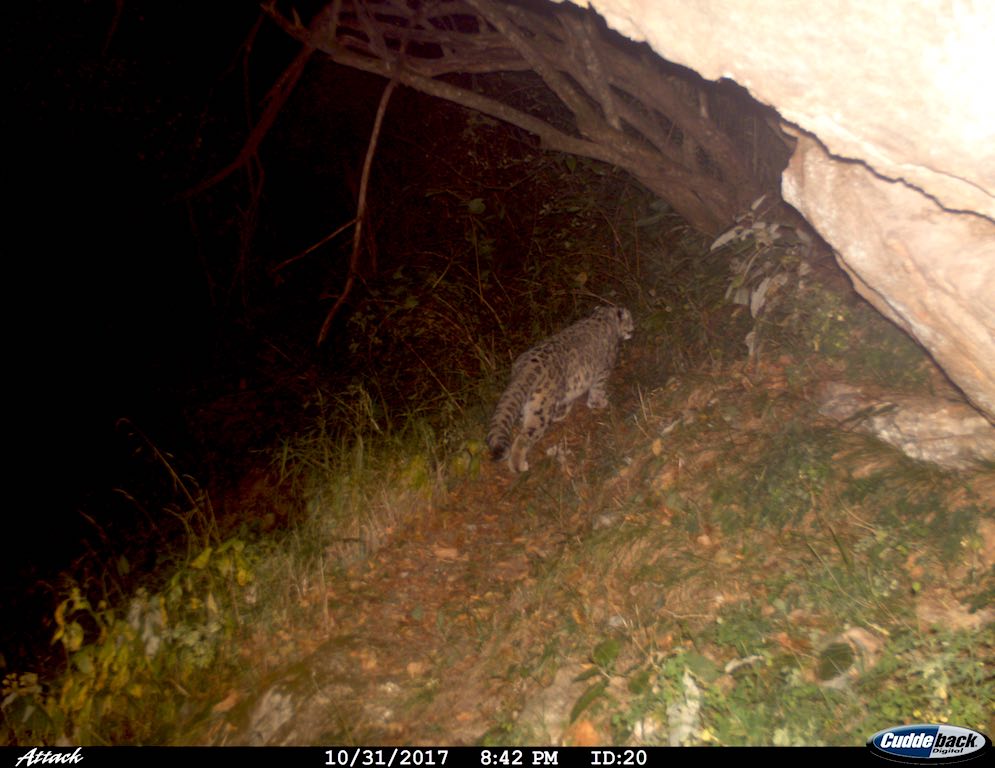
Research scholars from the Wildlife Institute of India, Dehradun, spotted a snow leopard in the Great Himalayan National Park (GHNP) yesterday. Senior scientist of the institute K Ramesh confirmed that a team carrying out research work was able to take photographs of the snow leopard at an altitude of about 2,700 m. It was for the first time that photographic evidence of the presence of the elusive species in the GHNP was confirmed, he added.
Snow Leopard picture captured by trap camera in GHNP October 2017

Snow Leopard picture captured by trap camera in GHNP October 2017

Ramesh said various scholars were carrying out research in the GHNP on rare species of animals.Snow leopards were rarely spotted in the area by residents and that too at an altitude of 3,500 m and above. A native of Central and South Asia, snow leopard is listed as a ‘vulnerable’ category animal on the ‘Red List’ of threatened species compiled by the International Union for Conservation of Nature (IUCN)GHNP director RS Patiyal said, “This is perhaps for the first time that the presence of a snow leopard has been reported through a camera trap photograph from the GHNP area.” He added that the presence of rare species in the area was a good sign.The GHNP authorities are unaware of the exact number of snow leopards in the national park. Snow leopards and other rare species are protected under the strict guidelines of the Wildlife Protection Act-1972, which is why any sort of hunting is prohibited in the area.The director said the presence of animals such as blue sheep, snow leopard, Himalayan brown bear, Himalayan thar and musk deer had been noticed in the park area, but photographic evidence of the presence of snow leopard was documented for the first time. He said with the efforts of conservation of rare species of animals present in the area, they were hopeful that the strength of such vulnerable species would increase in the near future. He said the GHNP would install 35 CCTV cameras in the park to track and monitor various rare species present in the area. The measure would also help check poaching. The Great Himalayan National Park (GHNP) was declared a protected reserve in 1999 and a UNESCO World Heritage site on June 23, 2014. Panky, a resident of Hamani village, said it was a good sign that rare species of fauna and flora was increasing in the area due to the conservation efforts of the government.

Photographic evidence documented for first timeÂ

  • Snow leopards are rarely spotted in the area by residents and that too at an altitude of 3,500 m and above.
  • They are listed as a vulnerable category animal on the ‘Red List’ of threatened species compiled by the International Union for Conservation of Nature.
  • Photographic evidence of the presence of snow leopard has been documented for the first time.
  • Snow leopards and other rare species are protected under the strict guidelines of the Wildlife Protection Act-1972.
  • The Great Himalayan National Park (GHNP) was declared a protected reserve in 1999 and a UNESCO World Heritage site on June 23, 2014.
Published in The Tribune [External link]

http://www.tribuneindia.com/news/himachal/snow-leopard-spotted-in-kullu-national-park/510318.html

Official Logo of the
Great Himalayan National Park

Website Related Links
  • Accessibility Statement
  • Downloads and Plug-ins
  • Website Policies
  • Terms & Conditions
  • Disclaimer
  • Credits
  • Help
GHNP Related Links
  • Park Organisation
  • RTI
  • News & Articles
  • Media & Press
  • GHNP’s Blog
External Links
  • India’s Portal
  • Himachal Pradesh’s Portal
  • District Kullu’s Portal
  • Himachal Tourism’s Portal
  • HP Government Holidays
  • Emergency Contacts
Conservation
  • Conservation Overview
  • Known Pressures in GHNP
  • Present Day Scenario
  • Institutional Framework
  • Management Plan
  • Protection Measures
  • Research and Monitoring
  • Conservation Education
Website Designed and Developed in the mountains by
Svaksha Technologies LLP

All Rights Reserved.

Content on this website is published and managed by Great Himalayan National Park Authorities. For any query regarding this website, please contact the Web Information Manager.

Hit Counter 770906

Last Updated 03 September, 2025

Hey! We need something to search for

The search field cannot be left empty. Please enter a valid search term or keyword to help us find the results you’re looking for.